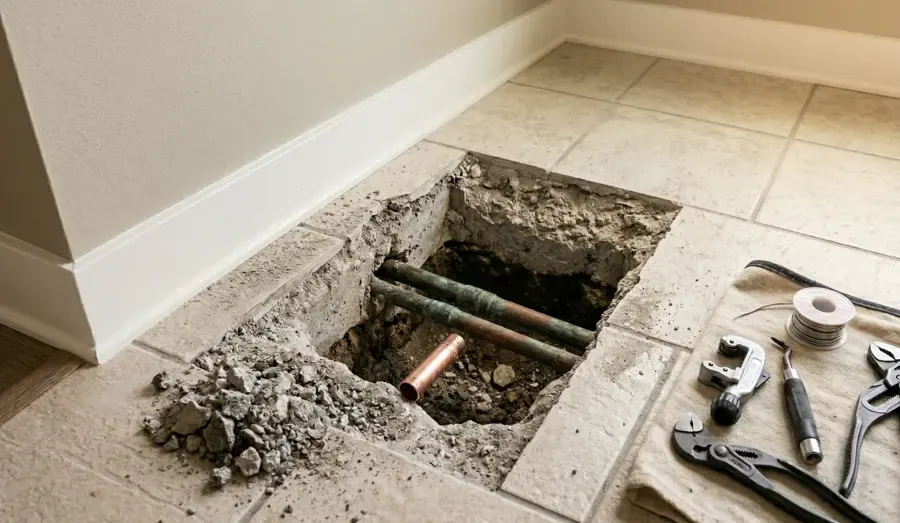
Under-slab leak damage

Slab Leak Water Damage in Palmdale, CA

A warm spot in the floor, a lifted plank or a water bill that jumped: slab leaks soak Palmdale flooring from below. The drying team finds the wet footprint and dries it out.

(888) 774-9605Get extraction started in Palmdale
IICRC S500 drying standard Truck-mounted extraction 24/7 dispatch
Tile floor and slab opened to expose a leaking copper line in a Palmdale home
Water categoryCategory 1
Common inSlab-on-grade tracts
Key toolsThermal imaging
Typical dry time4 to 7 days
Typical cost

What does slab leak water damage cost in Palmdale, CA?

In Palmdale, CA, slab leak water damage restoration typically runs $1,500 to $10,000 or more, not counting the plumbing repair, depending on how much flooring is wet, whether it has to come up and how long the leak ran.

Caught early
$1,500 to $3,000
  • One room of flooring
  • Pad and tack strip pulled
  • Slab drying
Spread under floors
$3,000 to $6,000
  • Several rooms or a hallway
  • Planks or tile removed
  • Dehumidifiers and daily logs
Long-running leak
$6,000 to $10,000+
  • Wide wet footprint
  • Walls and cabinets wet
  • Extended slab drying

What moves the number: the size of the wet footprint, the flooring type over the slab, how many days the leak ran, and how fast drying started.

For a closer planning range, try the water damage cost calculator. These ranges are typical, not a quote.

Do this now

What to do the moment you find slab leak damage

  1. Shut the main

    Close the main water valve to stop the pipe under the slab.

  2. Turn off the water heater

    If the leak is on a hot pipe, switch the heater off so it does not run dry.

  3. Photograph the floor

    Record the warm spot, the stain and any lifted planks before anything moves.

  4. Call a plumber and the restoration team

    The plumber repairs the pipe; the restoration team handles the drying.

The process

How slab leak damage is handled in Palmdale

  1. Walkthrough and moisture map

    The tech who does the walkthrough finds the source and maps how far the water traveled, using thermal imaging and pinless meters.

  2. Extraction

    The extraction crew pulls standing water with truck-mounted extraction, so it leaves the building instead of moving to the next room.

  3. Drying set to the room

    The drying team sets air movers to each room's evaporation load and runs LGR dehumidifiers, with desiccants for dense Class 4 materials.

  4. Readings to dry

    Most crews record readings daily and pull equipment once wet materials read within 2 to 4 points of a dry reference.

Nearly every tract home built during Palmdale's growth years sits on a concrete slab, with supply pipes running through or beneath it. When one of those pipes wears through, water rises into the flooring above. The leak is hidden, so by the time a homeowner notices, the carpet pad, the tack strip or the underside of the laminate has often been wet for days or weeks.

Signs a slab leak is behind the water

  • A warm or damp patch on tile or carpet, often over a hot water pipe
  • Laminate or wood planks cupping or lifting in one area
  • The sound of running water with every fixture off
  • A water bill that climbs with no change in use
  • Baseboards swelling along one wall with no leak above it

A plumber confirms the leak with pressure testing and acoustic or thermal tools, then reroutes the pipe or opens the slab to repair it. The restoration side handles everything the water already reached. The EPA WaterSense Fix a Leak guidance explains how to use the water meter to check for a hidden leak.

Hear water running with everything off? Shut the main and call before the flooring lifts.

Call about a Palmdale slab leak

How slab leak damage is dried

The tech who does the walkthrough maps the wet footprint with thermal imaging and pinless meters, because the visible stain is usually far smaller than the wet area. Carpet pad and tack strip over the leak are pulled, and floating floors often come up so the concrete can breathe. Concrete gives up water slowly, so the drying team runs LGR dehumidifiers and air movers aimed at the slab surface, with desiccants for dense Class 4 materials when readings call for it. The structural drying page covers the general process.

Why slab leaks are common here

Long pipe runs under large single-story floor plans, decades of hard, mineral-heavy water and ground movement on desert soils all stress buried pipes. Homes from the late 1970s to the mid 1990s may also have polybutylene supply pipe in the walls and attic. Waiting on a slow leak lets moisture reach drywall and cabinets, and the EPA moisture and mold pages explain why that matters.

The slab is dry when the readings say so

Concrete can feel dry on top while it still holds moisture deeper down. New flooring laid on a wet slab can cup or lift, so most crews reinstall only after the slab reaches the drying goal.

Service area

Slab Leak Water Damage coverage across Palmdale

The restoration team handles slab leak water damage in every Palmdale ZIP and the Antelope Valley towns around it.

Palmdale, CA and the Antelope Valley

The Palmdale restoration crew handles slab leak water damage across Rancho Vista, Anaverde, Ritter Ranch, central Palmdale, Desert View Highlands and East Palmdale, plus Lake Los Angeles, Littlerock, Quartz Hill and Lancaster.

ZIP codes 93550, 93551, 93552, 93590, 93591 and 93599 are all covered.

See every neighborhood and ZIP covered
FAQ

Slab Leak Water Damage questions in Palmdale, CA

How do I know if I have a slab leak?

Common signs are a warm spot on the floor, running water sounds with fixtures off, lifted planks, or a jump in the water bill. A plumber confirms it with pressure testing and acoustic or thermal tools.

Who fixes the pipe and who dries the house?

A plumber repairs or reroutes the pipe. A restoration company handles the extraction, material removal and drying of everything the water reached.

Does the slab itself need to be dried?

Yes. Concrete holds water and releases it slowly. Flooring laid on a wet slab can cup, lift or grow mold, so crews dry it to a verified reading first.

Can tile over a slab leak be saved?

Often. Tile set on thinset usually survives, but the grout lines and nearby walls still need drying. Carpet pad and laminate over the leak are usually removed.

How long does slab drying take?

Four to seven days is typical for a contained area. A long-running leak or dense flooring can take longer, and equipment stays until readings reach the goal.

Is slab leak damage covered by insurance?

Many policies treat the sudden water damage differently from the cost of accessing and repairing the pipe. Coverage depends on your policy, so it is worth checking with your own insurer.

Emergency dispatch

Slab Leak Water Damage in Palmdale? Call now.

The longer the water sits, the further it wicks into slab, drywall and framing. The Palmdale water damage pros answer day or night.

Call (888) 774-9605 · 24/7 water removal